



Protecting What’s Inside: How PET Additives Keep Juice Fresh and Water Freshness
Why juice is a demanding application for PET
Juice is chemically vulnerable in two distinct ways:
Oxidation. PET is not a perfect gas barrier. Oxygen permeates the bottle wall and also enters via headspace at filling. Once inside, it degrades vitamin C (ascorbic acid), oxidizes flavor compounds, and causes browning — visibly and measurably shortening shelf life.
Photodegradation. UV light (and part of the visible violet spectrum) drives the breakdown of vitamins, natural pigments such as carotenoids, and aroma compounds. A juice that looks faded on the shelf has usually also lost nutritional and sensory quality.
Neither problem is solved by the polymer alone. Standard PET transmits a significant portion of UV-A light, and its oxygen permeability — while low compared to other commodity plastics — is not low enough for oxygen-sensitive beverages over a multi-month shelf life.
How the combined additive package works
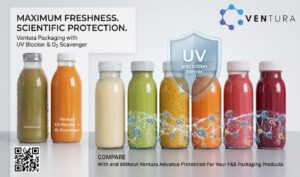
O₂ scavenger. An active-barrier additive dispersed in the PET matrix chemically binds oxygen — both the oxygen permeating through the wall over time and residual headspace oxygen. Unlike passive barrier layers, a scavenger doesn’t just slow oxygen ingress; it consumes it. This is the difference between delaying oxidation and actively preventing it during the critical shelf-life window.
UV blocker. A UV-absorbing additive incorporated in the melt phase absorbs harmful wavelengths (typically targeting up to ~390 nm) before they reach the product, while keeping the bottle visually clear. The consumer still sees the vibrant color of the juice — the juice just keeps that color longer.
Why combine them in one package
Oxidation and photodegradation are synergistic failure modes: light accelerates oxidation reactions, and oxidation products are themselves more light-sensitive. Addressing only one leaves the other pathway open. A combined O₂ scavenger + UV blocker masterbatch:
- Extends shelf life without switching to multilayer or colored bottles
- Preserves clarity — a key merchandising requirement for juice
- Simplifies dosing: one masterbatch, one addition point, consistent letdown ratio
- Keeps the bottle in the standard PET recycling stream
What converters should evaluate
- Scavenging capacity vs. shelf-life target: scavenger capacity is finite; dosing must match the intended shelf life and expected oxygen load.
- Induction time: some scavenger chemistries need activation (e.g., moisture-triggered); confirm behavior matches your fill process.
- Color impact at dosing rate: any additive can shift bottle color slightly at high letdown; run preform trials.
- Regulatory compliance: confirm food-contact approval (EU, FDA) for the target market.
Water Bottles — The Acetaldehyde Problem
Where AA comes from
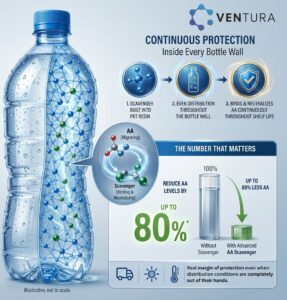
Acetaldehyde (AA) is a natural byproduct of PET thermal degradation. It forms during melt processing — injection molding of preforms in particular — when PET chains break down at high temperature. The AA becomes trapped in the bottle wall and slowly migrates into the contents.
For most beverages, this is irrelevant: juice, CSDs, and flavored drinks mask it completely. Water is the exception. With no flavor to hide behind, AA is detectable by consumers at extremely low concentrations — a faint fruity or plastic-like off-taste. For bottled water brands, whose entire value proposition is purity and neutrality, even trace AA is a quality failure.
Why hot climates make it worse
AA migration from the bottle wall into water is temperature-dependent. In markets across the Middle East and Africa, where bottles routinely experience storage and transport temperatures well above 30 °C, migration accelerates significantly. A bottle that tests clean in a temperate warehouse can develop a detectable off-taste after weeks in a hot supply chain. This makes AA control not just a quality refinement but a market-access requirement in hot-climate regions.
How the AA scavenger works
An AA scavenger additive, dosed into PET during preform production, chemically reacts with acetaldehyde as it forms — binding it into a non-volatile, non-migrating compound before it can reach the water. Ventura Horizon’s AA scavenger achieves up to 80% reduction in residual AA under standard test conditions.
The result: water that tastes like water, throughout shelf life, including under accelerated-aging conditions that simulate hot-climate distribution.
Practical benefits for water bottlers
- Taste neutrality maintained across shelf life and distribution temperature range
- Wider processing window: scavengers provide headroom when process conditions (regrind content, melt temperature, residence time) push AA generation up
- Compatibility with lightweighting: thinner walls mean shorter migration paths; AA control matters more, not less, as bottles get lighter
- No impact on clarity or bottle aesthetics at recommended dosing rates
One Supplier, Multiple Solutions
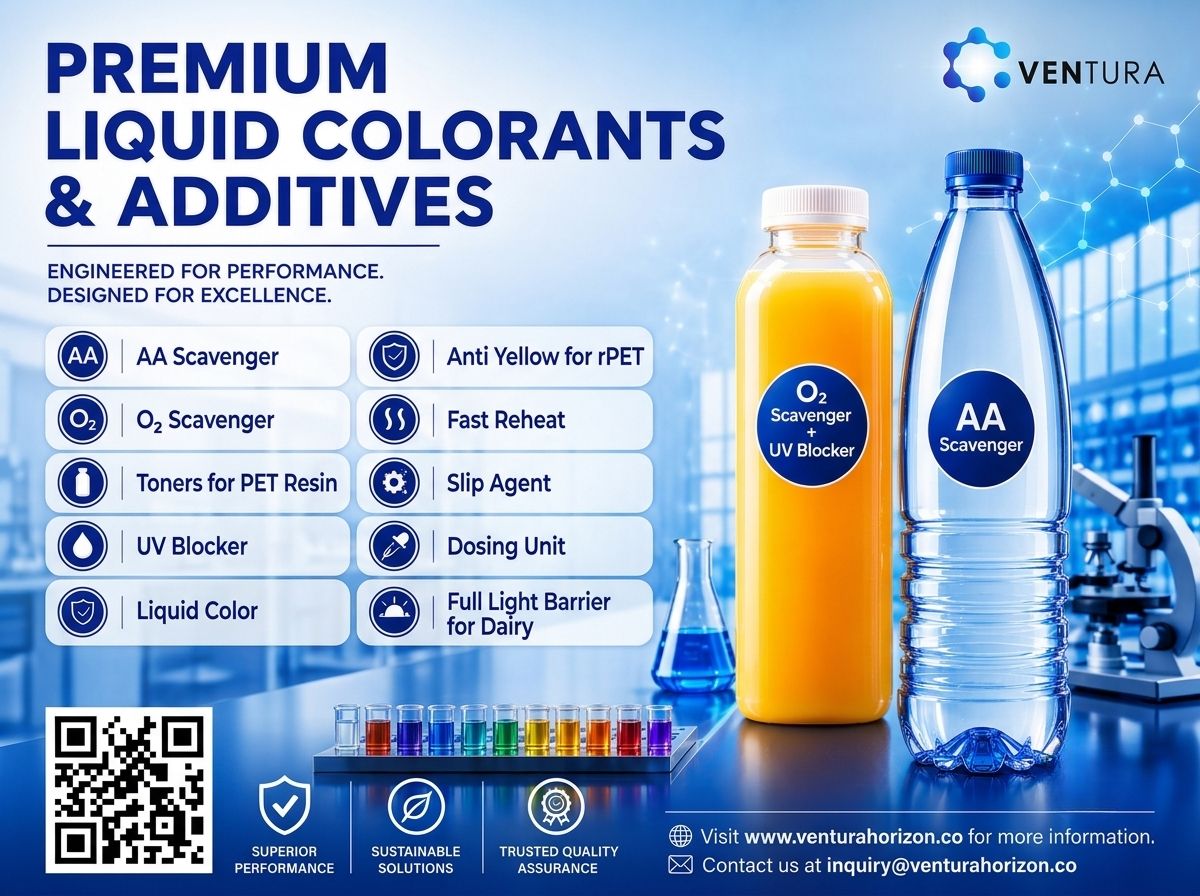
Both additive packages shown here — the O₂ scavenger + UV blocker combination for juice and the AA scavenger for water — are part of Ventura Horizon’s broader liquid colorant and additive portfolio for PET packaging, which also includes toners for PET resin, anti-yellow for rPET, fast-reheat additives, slip agents, and full light barrier solutions for dairy.
Liquid dosing at the press means precise letdown control, clean changeovers, and no dust — with dosing units available to match your production line.
Talk to us about your application
Every bottle, filling line, and distribution chain is different. Our technical team can help you match additive chemistry and dosing rate to your shelf-life target and market conditions.
Serving the Middle East, Europe, and Africa
Ventura Horizon Limited is proud to serve a diverse range of markets across three continents. Here’s where we operate:
Middle East: Saudi Arabia, United Arab Emirates, Qatar, Kuwait, Oman, Bahrain, Jordan.
Europe: United Kingdom, Germany, France, Italy, Spain, Netherlands, Belgium, Switzerland, Austria, Poland, Sweden, Norway, Denmark, Finland, Ireland, Portugal, Greece, Czech Republic, Hungary, Romania, Bulgaria, Slovakia, Slovenia, Croatia, Serbia, Bosnia and Herzegovina, Montenegro, North Macedonia, Albania, Estonia, Latvia, Lithuania.
Africa: South Africa, Egypt, Nigeria, Kenya, Ghana, Morocco, Algeria, Tunisia, Tanzania, Angola, Uganda, Botswana, Namibia, Senegal, Ivory Coast, Mozambique, Zambia.
No matter where your business is located, Ventura Horizon is equipped to deliver tailored solutions that drive success.



Leave a Reply